Small Stories from the Arusha, Especially Project in March 2025
Learning Problem-Solving
In the previous story, I talked about the first mentoring day for Tanzanian teachers. Today, I’ll share a story from the second day. The highlight of the afternoon was, of course, the distribution of laptops, which had actually been expected the previous week. Each mentor received one, as it makes perfect sense: it supports their daily practice in various tasks.
Before distributing the laptops, we had to implement Plan B—meaning that we handed out the Finnish participants’ laptops to the attendees so they could practice logging into webmail, using the available Canvas platform, and filling out Opeka (https://opeka.fi/fi), a survey designed to assess teachers’ digital skills, practices, and school-level digital integration.
We have decided to use Opeka to assess both the mentors’ skills and those of the teachers they are mentoring at their schools. The surveys serve two important purposes: they are required for reporting to the Ministry for Foreign Affairs, which funds the project, and they help with internal project evaluation. We are also considering the possibility of using the data for research, which means staying in touch with Opeka’s development team is necessary. The advantage of Opeka is that it is research-based, developed in Finland (which allows us to communicate directly with the developers), and has a parallel survey for students called Oppika.
Challenges Along the Way
Of course, there were some challenges… Today, when the mentor teachers filled out the English version of Opeka, many found the survey quite demanding. The language and the statements themselves were not necessarily familiar. Since digital skills were still developing, retrieving the password from an email wasn’t exactly a piece of cake—especially when the email password was missing, the Finnish-language application was hard to understand, or the firewall on a Finnish laptop was too strict. Lots of small hiccups! But we had a great team to assist. By the end of the day, only one person had yet to complete the survey.
I believe the benefits of Opeka will become clearer to the mentors once Aino (Korhonen) presents a summary of the mentor group’s responses. The mentors will receive their schools’ results once the mentoring process starts and they administer the same survey to teachers. The goal is for the results to support school-specific development.
Practicing Problem-Solving
Today involved a lot of small technical troubleshooting, which provided the mentors with valuable examples of the kinds of situations and challenges they may face in their own schools. One of the key areas of digital competence is problem-solving, and today, we practiced exactly that.
Alongside the Finnish trainers, two IT support staff members from Meru School played an extremely important role. Both are deaf and former students of Meru School. A young man who spoke the previous day also joined as a trainee, gaining valuable experience in guiding teachers. The IT support staff seemed to know exactly how to solve each problem—they were quick, friendly, and appropriately present. The participants, of course, could sign their questions, while the rest of us either used a sign language interpreter or wrote questions in English. This kind of professional IT support is essential for schools for the deaf and hard of hearing—just as it is for any other school.
By the way, I’ve really enjoyed learning Swahili sign language! I can already sign “we will eat soon” and “we will eat later.” I can say thank you, applaud (which is definitely not clapping), ask “how are you?” and respond in two ways: “I’m fine” or “I’m not fine, and I have a headache.” Of course, I also know how to wave goodbye!
Photos
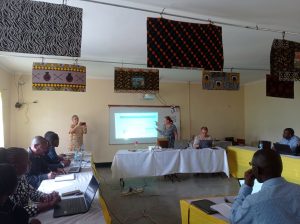
The first photo shows Aino Korhonen presenting Opeka. The classroom is decorated with beautiful fabrics to soften the acoustics.
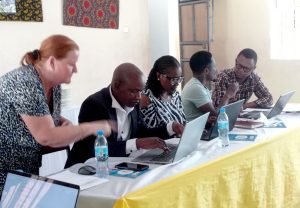
The second photo captures a practice session on accessing Opeka, with Aino assisting. Next to her are Paul A. Njile, Happiness W. Masaka, Vitus A. Mafafa, and Christopher Oswald.
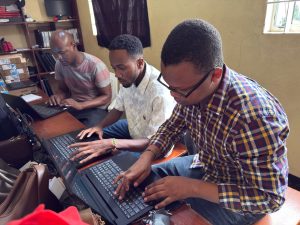
The third photo features the IT support team: from the left, Hillary Thobias, Jonathan Hoza, and Christopher Oswald.