Small Stories from Arusha 4
Arusha Ladies
How would anything get done without female energy?
This time, I thought I’d introduce the women involved in our project in the blog. Among the mentors participating in the training, there are four women and ten men.
We must start with the indispensable and determined key players in the project: Country Coordinator Nossim A. Mevoroo and Training Coordinator Mary N. Peter.
From an outsider’s perspective, it seems that Nossim works alongside the project leader, Antti Komulainen, networking, carrying out her tasks with determination and efficiency, and not being overly deferential—an essential quality in Tanzania’s male-dominated culture. Antti told me that Nossim first worked at a local school, managing the daily life of deaf and hard-of-hearing students in a boarding facility. After various experiences, she joined FSEA projects at Meru School as a volunteer. At that time, she was still completing her college studies, but with the support of Eva and Antti, she graduated from the Community Development program. FSEA needed a staff member to handle financial administration, and from there, Nossim advanced to become the country coordinator. Based on my brief acquaintance with her, I can believe she has just the firmness and determination needed. I witnessed her firmly dealing with local parking attendants who mistakenly locked Antti’s car. Guess who won the argument?
Mary N. Peter is a sign language interpreter by profession and is responsible for coordinating training in the project. She serves as a direct link between the mentors, schools, and project leaders regarding school implementation. I met Mary a few days before the training started, and we talked about whether we enjoy our work. Her eyes lit up as she told me that she loves her job and helping children and youth with disabilities. After seeing her interpreting, I have no trouble believing it.
Her first major task is to ensure that teachers complete the Opeka survey in schools. Quite a challenge, even though the survey is in English. Imagine a school with 55 teachers who have little to no digital skills, very few computers available, and complex English-language questions…
We brainstormed various solutions: the survey can also be completed on mobile phones (which are common), mentors have laptops that can be used, Mary will be on-site for a couple of days to assist, so that teachers don’t refrain from answering due to lack of confidence, and mentors will naturally help with the process. (The project needs the teachers’ responses for future reporting.)
I believe I have already written about how much I admire dedicated teachers. Last week, I saw another great example during a PowerPoint exercise. Each mentor was asked to create a PowerPoint slide introducing themselves. It was a great beginner’s exercise—combining text and images, using different formatting, etc. When the mentors presented their slides, one teacher wrote that they are proud to teach deaf and hard-of-hearing students. Such a statement is not necessarily common in Tanzania, as the teaching profession is not as highly regarded as it still is in Finland. However, among these mentors and sign language interpreters, the appreciation for teaching is strong! Eva Forssén, one of the project leaders, later told me that this future mentor is Sunday Mataula, the head of the hearing-impaired department at Meru School—definitely the right person for the job!
Another participant in the mentoring training is biology teacher Nyambuli Seif Maregesi, who is both deaf and visually impaired. She teaches biology at the secondary level in an inclusive classroom (Tanzania aims for inclusive education, where students of different abilities learn together). Her class may include deaf, hard-of-hearing, visually impaired, and physically disabled students. Nyambuli explained that she often teaches by pairing students with different abilities: for example, a visually impaired student who can hear helps their deaf peer. One of Nyambuli’s strengths is, of course, her proficiency in sign language. Additionally, she can also speak, as she became deaf as a teenager. She mentioned that one of her best qualities as a teacher is fostering an open environment where students feel free to ask questions and seek help. That is not always common practice in local schools. Nyambuli also shared that she truly enjoys her work.
Tanzania still faces significant issues with sexual harassment and violence against women. Women are often considered second-class citizens. That is why it is especially important to have female role models for deaf and other disabled girls and young women—examples of women who can develop their skills, earn their own income, and work independently.
Liisa Ilomäki

Photo: Sunday Mataula, Head of the Deaf Unit at Meru School
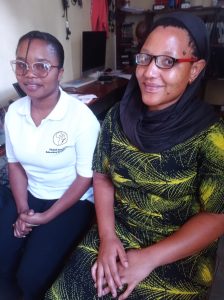
Photo: Sign language interpreter Witness Stephen and biology teacher Nyambuli Seif Maregesi
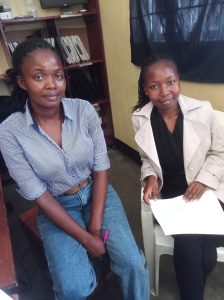
Photo: Nossim and Mary